Friday, April 1, 2016

U.S. Issues Statement On the Ugandan Government’s Post-Election Conduct

Press Statement
John Kirby
Assistant Secretary and Department Spokesperson, Bureau of Public Affairs
Department of State
Washington, DC
March 11, 2016

The United States reiterates its ongoing concerns with Uganda’s post-election environment, in which the government and its security forces persistently have violated the rights and freedoms of Ugandan citizens and the media.

The continued detention of opposition figures without legal justification, the ongoing harassment of opposition supporters, interference in legal challenges to the election results, and the intimidation of Uganda’s media are unacceptable activities in a free and democratic society. Recently proposed legislation to enhance the powers of the government to restrict media is an attempt to further limit the country’s political space.

The United States and Uganda have a long standing and strong partnership that has contributed to the stability and prosperity of the region. We are concerned that the Ugandan government’s recent actions could endanger the economic and political progress that has enabled our relationship to grow. We urge the government to take prompt action to reverse this troubling trend.

U.S. Announces New Measures To Address Drought in Ethiopia


Briefing on Announcement of New Measures To Address the Drought in Ethiopia

Special Briefing
USAID Administrator Gayle Smith
Washington, DC
March 3, 2016

MR KIRBY: Afternoon, everybody. Today at the briefing I’ve got a special guest who’s going to kick it off for us – USAID Administrator Gayle Smith, who you all have seen before. She’s going to give you an update on what USAID is doing to mitigate the effects of drought in Ethiopia. She’ll be able to stick around for a couple of questions, and then we’ll get on with the rest of the daily briefing. I will moderate the questions if you don’t mind, so in order – in the interests of time, please identify who you are, who you’re with, and let’s limit the follow-ups as best we can so we can keep things moving.

With that, ma’am.

ADMINISTRATOR SMITH: Thank you. Good afternoon, everybody. I imagine some of you have been following this phenomenon called El Nino, which is striking hard at a number of parts of the world, nowhere harder than in Ethiopia. We are also tracking its impacts in Latin America, and we are receiving information that it appears to be far worse in Southern Africa than we had hoped.
We began responding to the impacts in Ethiopia in the fall. We track these things, looking at weather and market data. It is at the point now where over 10 million people are in need. The United States has, to date, provided $500 million. In January, I was able to join in Ethiopia the Secretary-General of the United Nations, UN agencies, and the EU in a session where we collectively looked at what we needed to do.

We are announcing today that we are going to take a step as a contribution to that and one that we hope will lead the rest of the international community, which is to deploy what we call a disaster assistance response team. This is a group of experts that allows us to take a response that has been robust to date but to accelerate and expand it.

Our aim, though, is different than it often is. Most times we deploy a DART at the height of an emergency. We are moving earlier in this case because we have found that there is real alignment between donors, NGOs, the government, and UN agencies that if we move very, very, very quickly, we can avert the worst impacts of this drought.

Now, I don’t want to underestimate the fact that it’s already having impact. There have been losses to livestock. There are signs and growing signs of malnutrition. We are at risk of poor farmers invoking coping mechanisms and thus becoming poorer and more vulnerable over time. But again, the important thing here is this is almost an act of emergency prevention. If we move now, if other donors, if others move with us, we think we can do two things: avert the worst impacts, and protect some of the development gains that that country has made over many years.

The UN estimates that what is needed urgently over the next three months is $268 million. We are also moving seeds, $4 million worth of seeds very quickly now. This is another critical factor for farmers. Obviously, if they’re able to make the planting season, they will not be dependent in the coming year.

So our team will be led by a woman named Kate Farnsworth. She is one of our most experienced DART leaders. And again, what they will do is work with partners, the government, the UN agencies to expand and accelerate the response to this.

I will conclude just by reinforcing the point that this is something different. We are challenging the world not just to respond to human suffering, but to respond quickly enough to prevent something even worse. So with that, I’m happy to take questions.

MR KIRBY: Arshad.

QUESTION: Two quick things. You said, I think, that the need was $268 million.

ADMINISTRATOR SMITH: For the next three months.

QUESTION: Yeah. How much is the United States going to contribute toward that need? And then second, you talked about poor farmers adopting coping strategies that would make them even poorer. What do you mean by that?

ADMINISTRATOR SHAH: Sure. On your first question, we have provided over $500 million to date, and we are prepared to look at more. As I say, we’re doing the seeds now. Part of what a DART team does is, with other partners who are responding, looks at what the gaps are, what the needs are.

Where we need to respond, we will. But the other thing we are doing – and part of the reason we are announcing this in the way we are – is we are asking our partners in the donor community to move with us. So we will cover gaps as they are needed, but we’re also working very hard to make sure other countries step up.

What happens in a situation like this to those who are the most vulnerable, the extreme poor, is that if a harvest is short because of a drought, they have very few choices. They may be forced to sell their livestock; they may be forced even to sell their tools and implements. We’ve seen a lot of cases where they’re forced to eat their seeds as a matter of survival. You get into a worst-case scenario if they’re forced to sell their land or abandon their land for temporary employment.

Now, one of the things that’s happened in Ethiopia, which we have been proud to support but is something we are doing around the world much more in earnest, is work that we frame under the banner of resilience, which is designed to reduce the vulnerability of extremely poor people to the kinds of external shocks they experience all the time, right – droughts, conflicts, whatever it may be.

In the case of Ethiopia, there’s been considerable progress of something called the Productive Safety Net Program, for example – we were able to visit it recently – where through harvesting small amounts of water that can be used for livestock for people and for agriculture they can build a buffer so that when people face things like drought they’ve got something additional to fall back on, so that, if you will, there are more coping mechanisms. And we avoid what often happens in crises like this, is that the poorest people cope; they may survive, but they end up poorer coming out of a crisis than going into it.

MR KIRBY: Ros.

QUESTION: Hi, Rosiland Jordan, Al Jazeera English. Madam Administrator, one of the complaints that we’ve heard from people in the more rural areas is that – not that the aid isn’t available, but they worry about it being diverted for political reasons. Given that there is such a pronounced effort to try to prevent widespread malnutrition and a possible famine, what is the U.S. doing to encourage the Ethiopian Government to not let this sort of political diversion happen, as you get closer to the communities that are really in need?

ADMINISTRATOR SMITH: Yeah. Look, making sure that assistance gets to the areas where it’s needed is a priority and something we focus on in every operation we conduct. In this case, one of the things that has been done – and this has been a joint exercise of everybody responding to this – is mapping out the areas that are worst effected. So there are actually maps that show these are the areas we need food, this is when we need it, this is the level of vulnerability.

So our first-order effort is to follow the map, right. So we have facts and evidence that show us where the assistance is needed the fastest and what kind of assistance. There are 2 million people who are facing acute water shortages. These are people who rely on livestock. So the evidence and the facts drive us in the first instance. We and our partners always have in place robust monitoring systems to make sure that it gets where it needs to go. So that’s basically the way that we will approach this.

MR KIRBY: Matt.

QUESTION: Hi. Matt Lee with AP. I’m just wondering, the 500 million is since when that the U.S. —

ADMINISTRATOR SMITH: That is since the fall of 2015.

QUESTION: That’s – and who else has contributed? Has anyone else?

ADMINISTRATOR SMITH: Yes. The European Union, the UK, Canada, obviously UN agencies. There is a UN appeal, and in some cases you look at some other appeals, the response has been reasonably prompt, but it’s insufficient. And so one of the things we agreed at the event we did with the Secretary-General is to be a little bit more forward-leaning in saying here’s what we need by what date in order to fight and try to keep ahead of the impacts of the drought.

QUESTION: Right. The 268 that is needed is on top of the 500 million that you —

ADMINISTRATOR SMITH: Yes. That’s over the next three months

QUESTION: — and what every – and what everyone else has already contributed as well?

ADMINISTRATOR SMITH: Yeah. There’s a base of what’s already been provided. So that’s 500 million, plus what others have provided. What we’ve done is looked at – we’ve got the maps. We know where people are, what the needs are, and done an estimation – the UN has – of here is what we need over the next three months to manage this in such a way that we minimize to the greatest extent possible people falling further behind, right, so just to keep on top of it for three months.

QUESTION: So —

QUESTION: In addition to what you already have in hand?

ADMINISTRATOR SMITH: Yes, this is above and beyond what’s already been done.

QUESTION: So – but so – and this is my last one – so you are looking for – hoping people will follow your – the U.S. lead here —

ADMINISTRATOR SMITH: Yes, indeed.

QUESTION: — by contributing more money or by sending DART – their equivalent of a DART team?

ADMINISTRATOR SMITH: Different countries respond in different ways, so I think that’s their call whether they need more personnel. I think the first order of business is we need the resources by dates certain in order to keep ahead of this. Because, as you all know very well, what too often happens is we wait until the newspaper and the televisions are littered with images of starving children. In this case, there is a great deal of human suffering now, but we think it’s more prudent to get ahead of it.

MR KIRBY: Okay. Thank you very much.

ADMINISTRATOR SMITH: Thank you all very much.

QUESTION: Thank you.

QUESTION: Can you take one more question?

MR KIRBY: Yeah. Can we take one more?

ADMINISTRATOR SMITH: Sure.

MR KIRBY: Go ahead.

QUESTION: Thank you. So what can you tell us about the magnitude? Ten million people – for how many months do they need the assistance?

ADMINISTRATOR SMITH: Yeah. That’s a good question. The way we look at that – I mentioned Southern Africa, for example. When we began looking at this – and one of the things we are able to do through our early warning system is look at things on a constant basis. Southern Africa is looking to be worse than we had thought. And in the case of Ethiopia, we are constantly looking at the numbers to try to determine are we staying at 10 or are we moving to 11 or are we getting ahead and moving down. So that’s an iterative process that’s done on a regular basis.

The way those numbers will work is, if there is a response that is timely, those numbers will be level for a while and come down. The longer it takes for the world to respond to this, the greater the chance that those numbers will come up. And I – if you want to follow this, we – the United Nations and the government – will be constantly updating the numbers based on the latest information that we have.

QUESTION: In the case of Ethiopia, how much money is the government putting forth? Because there has been announcement —

ADMINISTRATOR SMITH: Yeah. The government has actually put forth a fair amount of money. As I recall – and don’t quote me on this; I think you should ask them for the number – they were, I think 350, 400 —

QUESTION: 1.2 billion is what they said.

ADMINISTRATOR SMITH: No, no, no. Well, maybe. Maybe. That may be their number. I’m aware of the last announcement they made when I was there, which was significant. I think what is significant here is the government is responding and they are putting money into the mix and doing their equivalent of kind of an emergency request and adding money to the budget. But I would refer to them for the exact numbers.

QUESTION: Thank you.

ADMINISTRATOR SMITH: Thanks very much.

MR KIRBY: Thanks, Gayle. Appreciate it.

Security Governance Initiative: 2015 Review

Security Governance Initiative: 2015 Review

Report
Bureau of African Affairs
March 2, 2016

Enhancing the transparent, accountable, and legitimate management and oversight of security policy and practice

Overview

At the U.S.-Africa Leaders Summit in August 2014, President Obama launched the Security Governance Initiative (SGI), a multi-year effort with $65 million in initial funding between the United States and partner countries to improve security sector governance and capacity to address threats. SGI partners with countries to undertake strategic and institutional reforms required for governments to tackle key security challenges. Together with our six current partners – Ghana, Kenya, Mali, Niger, Nigeria, and Tunisia – SGI is making great strides to focus on shared security priorities and enhance security sector management. Each of the six countries has demonstrated partnership with the United States, expressed a desire to strengthen its security sector, and committed to the core elements of the initiative.

SGI’s central objective is to enable partner countries to develop and enhance policies, institutional structures, systems, and processes that allow them to more efficiently, effectively, and responsibly deliver security and justice to their citizens. SGI is not a tactical-level training and equipping program, but rather focuses on supporting partner country efforts to improve the management, oversight, accountability, and sustainability of security sector institutions.

SGI uses Presidential Policy Directive 23 on Security Sector Assistance (PPD-23) as a policy framework to ensure transparency and coordination across the U.S. government, and to help partner countries not only build sustainable capacity to address common security challenges, but also to promote universal values such as good governance. In line with PPD-23, SGI is also designed to share information, expertise, and lessons learned within the U.S. government and beyond to improve other ongoing and potential future security sector assistance.

Approach & Principles

SGI leverages expertise and experience from the Departments of State, Defense, Justice, and Homeland Security, the U.S. Agency for International Development, and the National Counterterrorism Center. Coordination and collaboration both within the U.S. government and with partner countries is a hallmark of SGI.

The SGI approach is based on the recognition that sustainable solutions to security sector challenges must come from within the country. SGI launches a dialogue between the U.S. government and partner countries to share experiences and sound practices, and identify opportunities to tackle urgent and emerging security challenges, while endorsing principles of good governance.

→ SGI applies a comprehensive, whole-of-government approach, focusing on the systems, processes, and institutions that reinforce democratic security sector governance.

→ SGI conducts joint analyses, shares data, and agrees on goals with partner countries.

→ SGI regularly measures and evaluates progress through consultation and dialogue with security sector stakeholders in partner countries.

→ SGI matches targeted investments with willing partners to strengthen military and civilian institutions.

→ SGI consults with a broad audience, including civil society, international donor partners and other non-governmental organizations (NGOs), to ensure a thorough understanding of issues and efforts to address security sector governance challenges.

Management

The Department of State’s Bureau of African Affairs established an SGI Coordination Office that includes liaison officers from other U.S. government agencies. State also convenes an SGI Working Group to coordinate with the broader SGI interagency community. The SGI Coordination Office closely works with U.S. Embassy country teams in partner countries, which play a critical role in SGI program development and implementation.

Applying PPD-23’s central tenets of transparency and coordination across the U.S. government, the SGI Working Group includes all relevant U.S. government agencies working together to synchronize efforts, reduce redundancies, minimize assistance-delivery timelines, ensure consideration of the full range of policy and operational equities, improve data collection, and measure effectiveness.

National Security Council staff coordinate the interagency to drive implementation and engage senior interagency stakeholders at key decision points.

Process

Phase One – Pre-Consultation Coordination: Before traveling to a partner country for an initial visit, the SGI Office gathers information and organizes briefings with U.S. government and non-governmental country and subject matter experts. The SGI Office also arranges information-sharing and planning sessions with U.S. Embassy country teams to develop a shared understanding of the U.S. interests at stake, discuss the country-specific situation, and identify potential areas for engagement. The partner country assigns a senior SGI Point of Contact, usually in the Office of the President, to coordinate SGI engagement within its government, and provide oversight, access, and visibility to fulfill SGI objectives.

Phase Two – Consultation Visits: Multi-agency U.S. government teams visit SGI partner countries to meet with government representatives, non-governmental stakeholders, and international donors to identify challenges as well as opportunities for SGI to support partner country efforts to improve security and justice institutions. Based on priorities articulated by a partner country, the U.S. government proposes areas for SGI to focus. This identification and framing of requirements by partner countries is essential to the SGI process and will contribute to its success.

Phase Three – Development of Joint Country Action Plan: Once the United States and the partner country agree on the focus areas, the Joint Country Action Plan (JCAP) is developed to define the parameters of the SGI partnership. U.S. and partner country experts jointly conduct an analysis of the challenges and opportunities available in each focus area, to include reviewing any related and parallel activities. These expert teams then articulate the goals for each focus area and recommend activities, required steps, and milestones for achieving desired end states. A Senior SGI Steering Committee, co-chaired by U.S. officials and partner country counterparts, meets to review and approve the analysis and recommendations, and to develop a plan and schedule to monitor SGI activities and review SGI progress. The final JCAP is presented to U.S. and partner country leadership for signature.

Phase Four – JCAP Implementation: Using the JCAP as the roadmap, focus area teams design and implement programs to reach goals through a variety of bilateral engagement such as: technical assistance, mentoring, and workshops. Steering Committees convene periodically to review progress, modify goals as necessary, and agree on next steps.

Outreach

Outreach contributes greatly to SGI’s success. SGI outreach goals are to: 1) familiarize a wide range of stakeholders with the SGI approach and principles; 2) create opportunities for engagement and dialogue with technical experts to inform SGI analysis and implementation; and 3) coordinate SGI planning and implementation with key stakeholders to foster complementary activities and avoid duplication of efforts.

Key SGI Stakeholders

→ Civil Society Organizations: U.S.-based and SGI country-based think tanks, academics, advocacy groups, and other NGOs possess SGI country and regional expertise. They also have security sector governance subject matter expertise that provides valuable perspectives for SGI planning and programs. SGI leadership hosts information sessions with civil society organizations in Washington to provide updates on SGI progress, while soliciting ideas and support. Interagency delegations also meet with civil society organizations in SGI countries.

→ International Donors: Through consultations and coordination with other international partners in Washington, donor capitals, and SGI countries, SGI seeks to maximize the impact of security sector governance reform efforts by sharing information to ensure complementary activities.

→ Partner Country Representatives in Washington: Regular contact with SGI partner country embassies in Washington provides the opportunity to brief ambassadors on SGI activities, discuss security sector governance challenges, and receive feedback from senior level SGI partner country representatives.

Lesson Learned

Since its launch in 2014, SGI has tackled challenges and learned from these experiences. The following are key lessons that have shaped SGI thus far.

→ A steadfast commitment is required by partner countries, U.S. government interagency partners, and U.S. embassies for SGI to succeed. Each plays a unique and important role in ensuring appropriate SGI management, coordination and prioritization of efforts, and in identifying opportunities to contribute to long-lasting reforms.

→ Civil society and international donor partners provide a vital perspective. Establishing an SGI community is critical to share best practices and ideas, provide for a more rigorous analysis of security sector governance, and prevent the duplication of efforts.

→ The SGI process has helped both the U.S. government and partner country governments develop whole-of-government strategies and exchange information to address security challenges. PPD-23 provides a useful model for developing U.S. government coordination mechanisms.

→ Defining milestones and measuring results help determine the efficacy of the SGI approach and process. The development of a monitoring and evaluation framework is important to guide SGI implementation and decisions on next steps for country-level engagement, as well as the future of SGI more broadly.

Ghana

The Government of Ghana (GOG) has signaled its commitment to the SGI process, principles, and partnership, by conducting frank conversations about security sector governance, and proactively organizing inter-ministerial working groups to support the implementation of SGI activities. The SGI-Ghana U.S. Head of Delegation is Ambassador Susan Page.

September 2015
• Focus Areas Approved

October 2015
• JCAP Drafted

February 2016
• JCAP to be Signed

Focus Areas
1. Maritime Security
2. Border Management
3. Cybersecurity and Cybercrime

→ Cross-cutting Theme: Administration of Justice

SGI Engagement: SGI consultations prompted senior inter-ministerial dialogue on critical security governance challenges, sparking candid analysis of interagency processes, responsibilities, and gaps. This yielded an unexpected SGI focus area for Ghana – cyber security and cybercrime. Ghana ranks second in Africa in the number of web-based crimes occurring each year, and many victims are in the United States. The GOG also relies more extensively than many countries in Africa on electronic financial transactions, which if not properly secured are vulnerable to attack. At the GOG’s request, SGI will partner with Ghana to develop clearer authorities to prevent, investigate, and prosecute cybercrime.

Ghana also faces a variety of maritime security and land border management challenges. Offshore, threats undermine safety in its coastal waters as well as hurt prospects for economic development, including piracy, terrorism, oil bunkering (theft), narcotics trafficking, illegal fishing, and environmental degradation. Onshore, enhancing border management is necessary in order to address porous land borders that allow Transnational Criminal Organizations to engage in drug and human trafficking, bulk cash smuggling, and the illicit flow of small arms and light weapons, all of which threatens the safety of the populations around the borders and legitimate trade and commerce. Established in 2002, the Ghana Maritime Authority provides an opportunity for SGI to support improved coordination across Ghanaian agencies responsible for various aspects of maritime security. Similarly, SGI will help the GOG improve land border management by supporting the establishment of an interagency border management group to clearly define the roles, responsibilities, and legal authorities needed to empower border security agencies to ensure appropriate oversight, enforcement, and accountability.

Kenya

September 2014
• Initial Consultation Visit

February 2015
• Focus Areas Approved

March 2015
• JCAP Drafted

May 2015
• Kenyan Prosecutors Visit US

June 2015
• Border Advisor Deployed
• Integrated Border Management Architecture Workshop

July 2015
• JCAP signed

August 2015
• IBM Strategic Planning Workshop in Washington, DC
• Police HRM Infrastructure Assessment

September 2015
• Evidence Workshop

November 2015
• Senior Steering Committee

Focus Areas
1. Integrated Border Management
2. Police Human Resource Management
3. Administration of Justice

→ Cross-cutting Theme: Countering Violent Extremism

The Government of Kenya (GOK) is enthusiastic about SGI and responded positively to initial outreach efforts. President Uhuru Kenyatta received the head of delegation and U.S. Ambassador to pledge the full support of his government to SGI, and quickly appointed a senior GOK point of contact to facilitate high level discussions on critical security sector governance issues. The progress made to date is due to excellent bilateral collaboration, and proactive steps Kenya has taken to meet desired SGI objectives. Kenya was the first of the SGI partners to finalize a JCAP, which was signed on the margins of President Obama’s visit to Nairobi in July 2015. The SGI-Kenya U.S. Head of Delegation is Ambassador (retired) Pamela Bridgewater.

SGI Engagement: The three mutually agreed focus areas for SGI-Kenya address shared security interests and challenges. The GOK identified thwarting the movement of terrorists across the porous Kenya borders, particularly the Somalia border, as one of its highest national security priorities. Through SGI, the U.S. government is working with Kenya on integrated border management to create a holistic border management program. This integration will ensure GOK’s capability to effectively manage both the legal and illegal movement of people and goods by land, air, sea, and rail in a coordinated and comprehensive manner.

Countering the threat of violent extremism requires the full participation of all members of Kenya’s diverse population. SGI is working with the GOK to enhance police human resources management and the administration of justice in order to foster greater public confidence in security institutions, prevent the marginalization of segments of Kenya’s population, remove obstacles hindering effective prosecution, and allow all citizens access to judicial resources and recourse.

Thus far, SGI has helped the GOK in its efforts to draft an integrated border management strategy; craft legislation to prevent illicit trafficking of Weapons of Mass Destruction (WMD), dual use technology, and conventional weapons; and completed an assessment of the current human resource management systems infrastructure for both the National Police Service Commission and the National Police Service. As part of SGI, Kenyan investigators and prosecutors examined U.S. methods of generating admissible evidence in terrorism cases.

Mali

January 2015
• Initial Consultation Visit

August 2015
• Focus Areas Approved

September 2015
• JCAP Drafted

December 2015
• JCAP Signed

January 2016
• Defense strategic planning workshop in Washington

Focus Areas
1. Alignment of Ministry of Defense Resources to Real Operational Needs
2. Police Human Resource Management
3. Improving Human Resource Management through a Justice Sector
Strategy

→ Cross-cutting Theme: Interagency Coordination

From the outset, the Government of Mali (GOM) and the Malian public have shown interest in and commitment to the SGI. In January 2015, newly-appointed Prime Minister Modibo Keita and his cabinet met the visiting SGI consultation team as his first international meeting. Local Malian press covered the SGI visit and the subsequent JCAP signing ceremony, providing an opportunity to share security governance principles with the Malian public. The SGI-Mali U.S. Head of Delegation is Ambassador (retired) Larry Wohlers.

SGI Engagement: The SGI process has provided insights into planned Malian justice reforms and the national security strategy. SGI has also provided a forum for Malian inter-ministerial discussions on security sector governance priorities, and the opportunity to explore innovative reform options outside of the current system of governance. The GOM demonstrated its commitment to security sector reform by independently taking actions to address SGI objectives.

Mali faces several security governance challenges as it works to consolidate and build on the 2013 restoration of democracy and implementation of a peace accord. The SGI focus areas seek to strengthen internal decision-making processes in key security sector institutions, particularly the Ministries of Defense, Security (police), and Justice. These include the systems and processes that oversee the budget, human resources, resource management, accountability, strategy, and policy. The police, for example, have not recruited new personnel since 2011, and existing recruitment efforts lack sufficient rigor to yield high-quality results. In all three agencies, challenges in managing logistics and matching resources to identified needs have reduced the effectiveness of security efforts. Improvements in these areas will make the provision of other U.S. assistance more effective, as well as assist the GOM in rebuilding effective security institutions in order to address its national security priorities, to include providing enhanced citizen security throughout the country and ensuring access to justice for all.

While the current security situation in Mali limits opportunities for SGI to engage in-country, a defense strategic planning workshop was held in Washington in January 2016 and programming to evaluate court procedures is underway in Mali.

Niger

January 2015
• Initial Consultation Visit

May 2015
• Focus Areas Approved

June 2015
• JCAP Drafted

October 2015
• JCAP Signed
• Conducted strategic framework and resource needs workshop

November 2015
• Conducted workshop on structures and processes required for improved external communication

January 2016
• Conducted workshops to enhance strategic planning, human resource management, logistics management, and budgeting
• Deployment of Embassy SGI Coordinator

Focus Areas
1. National Security Review and Strategic Framework
2. Alignment of Human and Material Resources to More Efficiently Address Short- and Long-Term Security Needs
3. External Communication

The Government of Niger (GON) has welcomed the SGI approach and appointed a senior-level official in the Office of the Presidency as the SGI point of contact. The President of Niger and Prime Minister both engaged with the local press during the SGI consultation team’s visit and highlighted SGI as a major feature in the future of the bilateral partnership. The SGI-Niger U.S. Head of Delegation is Ambassador (retired) Larry Wohlers.

SGI Engagement: Niger faces a variety of security threats that are acute and expanding. The GON has been effective in responding to the rapid rise in threats since 2012, but the SGI process identified the lack of a broader strategic security framework as one factor hampering the GON’s ability to comprehensively address these threats. SGI will work with the GON to develop a National Security Review and Strategic Framework to help the GON analyze current and emerging threats and efficiently allocate resources to address them.

These efforts will include developing systems to plan for multi-year programming, which is not currently possible in the Nigerien system. SGI will also work to help develop an approach to manage human and material security sector resources, including human resources, logistics, and budgeting. This is needed because each of Niger’s five security services currently manages separate and sometimes conflicting human resources classifications, recruiting, and oversight systems. These inconsistencies have eroded employee confidence and degraded the ability to effectively recruit. Enhancing consistency in job qualifications, management policies, procedures, and doctrine will help remedy these challenges. Finally, Nigerien security services struggle to effectively communicate with the public due to both a lack of established channels and insufficient experience. SGI will work with the GON to enhance its external communication in order to build public trust with its citizens.

As a result of keen interest and active participation, the GON has already proactively instituted several reforms, such as the Prime Minister’s call for each Ministry to appoint a designated media/communications contact to facilitate interagency communication and public outreach.

Tunisia


May 2015

• Initial Consultation Visit

October 2015
• Conducted pre-JCAP visit

February 2016
• Focus Areas Approved

March 2016
• JCAP Drafting

Focus Areas
1. Border Management
2. Police Policy, Procedure, and Community Engagement
3. Promoting Integrity and Addressing Radicalization in the Criminal Justice System

The Government of Tunisia (GOT) has expressed a strong interest in working on security sector reform issues through SGI. An SGI consultation team visited Tunis in May 2015 and November 2015. The Tunisian and U.S. governments reaffirmed a commitment to this multi-year partnership during other high-level engagements, including the U.S.-Tunisia Strategic Dialogue and the visit of President Caid Essebsi to Washington in May 2015. The SGI-Tunisia U.S. Head of Delegation is Ambassador (retired) Ronald Neumann.

SGI Engagement: Since the Arab Spring uprising in 2011, Tunisia has been working to institutionalize its new democracy. However, the GOT faces several security governance challenges as it works to counter its many threats. The three SGI focus areas in Tunisia address shared security interests. As in Kenya and Ghana, porous borders have facilitated the flow of armed groups, weapons, and illicit trade into Tunisia, contributing to Tunisia’s growing terrorist challenge. Under SGI the U.S. government will partner with the GOT to improve Border Management by enhancing coordination among the various ministries with responsibilities for border control. By improving police policies and procedures, especially with respect to community engagement, SGI will help the GOT build public support for its security forces, by enhancing their legitimacy and improving transparency, all of which are crucial to ensure citizen security.

Finally, SGI will work with the GOT to strengthen the judiciary and law enforcement agencies as legitimate democratic institutions and to help address key drivers of radicalization. This SGI partnership will facilitate a strategic approach to address these issues and identify Tunisian-led solutions to their most pressing security sector governance concerns.

Thank you to all that have contributed to the progress the Security Governance Initiative made in 2015.

For additional information please contact: info-sgi@state.gov

CAR Transitional President Catherine Samba-Panza Meets with Sec. Kerry

Photo: State Department

Remarks With Central African Republic Transitional President Catherine Samba-Panza

Remarks
John Kerry
Secretary of State
Treaty Room
Washington, DC
March 2, 2016

SECRETARY KERRY: So welcome, everybody. I am really pleased to be able to welcome the president of the Central African Republic, President Samba-Panza. She is one of three female presidents on the continent of Africa and has presided over a remarkable transition during very, very difficult times in the Central African Republic. She is known as the mother of the Central African Republic because she’s really presided over a very complicated and important process.

With her leadership, the Brazzaville Accords were reached in 2014. They helped to bring warring parties together in order to try to bring the country to an end of conflict, and later with the Bangui Forum in 2015, where there were further discussions about how to move forward and then a constitutional process and now an election. And President Touadera – President-elect Touadera will take office at the end of March, and we wanted to really underscore the importance to the United States of our relationship and particularly our admiration for the efforts of President Samba-Panza, who has really helped to set an example for stewardship, for responsible transfer of power, for holding good elections, for providing an example that really reaches well beyond the Central African Republic and to all of the rest of the – rest of the continent.

The United States has been deeply involved in trying to help in this transition. We’ve provided over $800 million combined in support, some of it to MINUSCA, which is the United Nations support effort for this, but also humanitarian aid, elections assistance, and long-term development support. And we are very committed going forward now to helping to support the new president in the transition, but it’s very, very clear that President Samba-Panza’s legacy is a very important one to the entire world, and we’re delighted to have her here today to talk about the ongoing United States commitment to the Central African Republic.

So Madam President, welcome. Thank you for coming to say hello, and I look forward to your comments.

PRESIDENT SAMBA-PANZA: (Via interpreter) Mr. Secretary of State, first of all, I would like to express my deep emotion, having listened to the words that you have spoken about me. Above all, I would like to express to you and to the United States Government the entire support, the entire help that I personally benefited during the transition. And thanks to that, I was able to complete my mission even though it was very difficult. I felt surrounded by friends, surrounded by people who really wanted to support the people of my country, people who wanted to help the country to recover, and amongst these friends there were, first and foremost, the United States of America. And for that, I would like to repeat – reiterate on behalf of the people of Central Africa, repeat my deep gratitude.

You know my country very well and you gave a very eloquent summary of the journey of this transition. First of all, you said something that has always struck me quite deeply. When we – I was called the mother of the nation – and it’s this position, this posture, that I always positioned myself – when I accepted, agreed, to lead the transition at a very difficult moment in time, it was because that I knew that as a mother, that as a woman, I had great opportunity to reconcile the sons and daughters of Central Africa who had been artificially divided due to religious regions and due to political reasons. And as a mother, as the mother of the nation and as the mother of all Central Africans, I always fought to bring around me all my citizens and all the men and women who had been divided over several years of conflict. I think that it’s thanks to this posture that I was able to help.

Alongside this posture, I had a vision, a vision that I had to put forth. I understood that through force we could not solve the problems of my country. So I put great emphasis on dialogue, reconciliation, consensus, social cohesion, and all of the efforts were geared towards that vision. And we also had to ensure security throughout the country, and in this regard, once again, the United States were of great help via the support that was provided to the peacekeeping forces of the United Nations and through the presence of American military in the zone of Obo to fight against LRA. This was a very important support.

And my main mission during the transition was to organize elections in order to bring back the country to a new constitutional order, and that was a challenge that had to be met. Today, I am proud to tell you that I was able to meet that challenge. We had peaceful elections. We have a new president who was well elected with a – more than 62 percent. And now it is up to all of us to help him rebuild the country. And the meaning of my trips is to be the advocate to ensure that the new government will continue to benefit from the support from our friends, from the international community, and from the United States of America to help us truly overcome this cycle of violence.

U.S. Official AttendsConference on Intra-Muslim Dialogue and Capacity-building in the CAR

Remarks
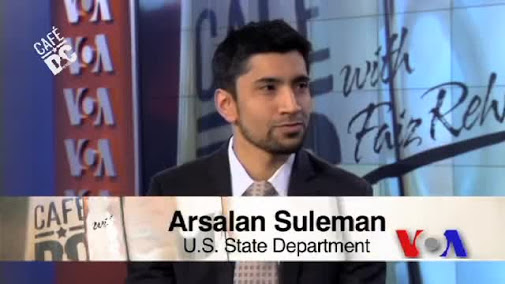
Arsalan Suleman
Acting U.S. Special Envoy to the Organization of Islamic Cooperation
Vienna, Austria
February 26, 2016

Your Excellency KAICIID Secretary General Muaammar, His Eminence Shaykh Abdullah Bin Bayyah, Madame Minister, Ambassadors, Honored Religious Leaders, Esteemed community leaders and representatives from the Central African Republic, greetings.

Thank you for allowing me the opportunity to add a few words to the fruitful discussion that has been taking place here at this conference. I am very pleased to join Ambassador David Saperstein in representing the US government at this important event. We would like to thank and congratulate our friends here at KAICIID, who have worked very hard to organize this successful conference, and also the Network of Traditional and Religious Peacemakers, particularly Dr. Mohamed Elsanousi, for his tireless efforts in fostering and supporting this intra-faith reconciliation and capacity building effort for the CAR Muslim community. We would also like to thank His Eminence Shaykh Bin Bayyah and the Forum for Promoting Peace in Muslim Societies for their important guidance and support for this effort, and to the OIC and Ambassador Ufuk Gokcen for their leadership and support.

As the Acting US Special Envoy to the OIC, I work with the OIC and its member countries, as well as civil society and multilateral organizations, to deepen and expand partnerships. We are constantly working to address questions of human rights, countering violent extremism, health, and education, among other topics.

It is inspiring to see this initiative come to fruition after a long series of consultations and discussions that began with the April 2014 visit of an interfaith delegation from the United States to support CAR inter-religious peace efforts, which included my predecessor Rashad Hussain, Ambassador Gokcen, and Dr. Elsanousi. In the last two days, you have made significant strides to identify the issues and challenges that exist for you as a Muslim community in the Central African Republic. As many participants have emphasized throughout these discussions, you must now unite to address these common challenges of reconciliation, social cohesion, and identity. This will help strengthen the ongoing national dialogue and reconciliation efforts in CAR, and enhance the capacity of your community to positively shape CAR’s future.

At each step, the US government will remain a committed partner to the various faith communities in CAR, including the Muslim community. We, like the other observers here, hope to help answer your calls for training and capacity building.

We will continue to look to you, the leaders of the Muslim community, including its youth and women, to clearly define your needs and goals so that organizations like the Network, the Forum, KAICIID, the OIC, and others can provide you with targeted and relevant support.

In a few weeks, a new President will take power in CAR. We see this as an incredible opportunity for a united Muslim community to redefine its relationship with the government and fully engage in reconciliation efforts.

Again, I want to reiterate the importance that the US government places on promoting social cohesion and reconciliation, and underscore our continued commitment to supporting your community and the population of CAR as a whole.

T‎hank you.

U.S. Issues Statement on Elections in Niger

Press Statement
Mark C. Toner
Deputy Department of State Spokesperson
Washington, DC
February 22, 2016

The United States congratulates the people of Niger for overcoming logistical challenges and participating peacefully in presidential and legislative elections that began this past weekend.

A peaceful post-election period is crucial to maintaining confidence in the credibility of the electoral process and in the results.

The United States remains committed to supporting the people of Niger in their pursuit of democracy, security, and economic growth and development.

White House Hosts African Diaspora Leaders Policy Forum


February 23, 2016
The White House
Washington, DC


By Sami Disu, Communications Director, United People for African Congress
(917)365-3563, contact@upac-usa.org

US African Representatives Attend White House Briefing, Demand Full Integration in America


Following decades of political and economic marginalization of the African population in the United States, over 100 African leaders and representatives from across the United States attended a White House briefing facilitated by Dr. Sylvester Okere, President of the United People for African Congress on Monday Feb. 22nd.

Pictures

On behalf of the US African population, Dr. Sylvester Okere, President of the United People for African Congress delivered a proclamation to the White House detailing immediate concerns of US African populations.

The historic briefing by members of President Obama’s policy team focused on US-Africa policy and included a subsequent strategic planning session at the Democratic National Committee (DNC) on Monday Feb. 22nd. Despite being among the most educated groups in the US, African populations continue to experience racial discrimination and bureaucratic barriers that have prevented the full integration of Africans into American life and economy.

“For far too long Africans have not been allowed to make their full contributions to this great nation,” said Dr. Sylvester Okere, President of the United People for African Congress. “We are very grateful that President Barack Obama has allowed us to make our case for full African integration in this country during Black History Month. As Americans, we have resolved to break through the artificial barriers that prevent us from full participation and contributions to the United States of America.”

“Politics is the vehicle by which all Africans must participate in ensuring our communities develop in vibrant and economically-sustainable ways,” said Deputy Mayor of the City of Newark, Hon. Ugochukwu Nwaokoro. “The status quo in African marginalization in this country is costly and unacceptable. As Africans in America, we have so much to offer and we must continue to agitate and organize for full participation in this nation’s politics. America rises as we overcome.”

“The issue of political under-representation is limiting the socio-economic development of all Africans in the US,” said Rosemary Segero, President, Segeros Int Group, Inc. “We are serious in calling for a proper count of Africans in the coming 2020 Census so that local governments can adequately service the language and social needs of our growing populations. We can’t wait for the 2030 Census to finally get a proper sense of where Africans are clustered in order to reach them effectively.”

“This gathering is just the beginning of the necessary and forceful political organizing we must continue to undertake for the most vulnerable in our communities,” said Amaha Kassa Esq., Executive Director, of African Communities Together. “The fate of thousands of Guineans, Liberians and Sierra Leoneans previously protected under Temporary Protected Status now hangs in the balance. We have come together to ask President Barack Obama to renew TPS and keep our families whole till Congress is able to pass the necessary comprehensive immigration reform.”

“I am heartened President Barack Obama is paying attention to the African community because Africans are best positioned in guiding this nation’s engagement with Africa,” said Rashida Bright, Executive Director, RISP America. “We are now Americans just as much as we are Africans. Why should America continue to lose out in trade with Africa when you have us here with our connections and inputs? We can help inform better policy development with Africa this very moment.”

“American policy and relations with Africa must reflect current realities and seize valuable opportunities in both places,” said Nii Akuetteh, Executive Director, African Immigrant Caucus. “This means President Obama deserves commendation for this outreach and briefing of which more are needed. It also means American leaders in every sphere, especially the next president, must grow and expand Mr. Obama’s numerous Africa initiatives. Above all, it means this: We the African immigrants must first and foremost put aside ethnic, national, sectarian and language differences; instead, we must unite and organize ourselves into a powerful voice that American decision makers are forced to heed and respect.”

“Africans in the US have already resolved to help change the Washington gridlock and to continue using our voice in service of justice, peace and the pursuit of the efforts to perfect the union,” said Dr. Hashim El-Tinay, Secretary General, United People for African Congress. “Our representatives aspire to bringing about a societal awakening that can transform the prevailing, dominant culture of racism and fear to one of solidarity, social, and economic justice. Our contributions are timely to facilitate the emergence of a new 21st century culture of trust that inspires the nation to build bridges rather than walls.”

“The previous census undercounted Africans due to the usual reason of cost savings for American taxpayers,” said Lansana Koroma, Chairman, International Forum for the Rights of Black People. “There could be millions of Africans here even though the government says 1 million. The Black youth population has ballooned just like in Africa. We are going to continue working with President Obama and My Brother’s Keeper because we must plan for the future of more than one generation.”

About Dr. Sylvester Okere


Dr. Sylvester Okere